How it works
Welcome to “LinkedIn or Interpol”, the deduction game where every face could be a linkedin professional or a very real wanted person from the interpol red notice.
Your mission is simple: for each photo, you have to guess whether this person belongs to the world of professional networking (“LinkedIn”) or to the world of international police alerts (“Interpol”).
1. The basic idea
Each round, the game shows you a single portrait. You have two buttons: and . You choose one, then the answer is displayed. If you get the answer right, the score counter increases.
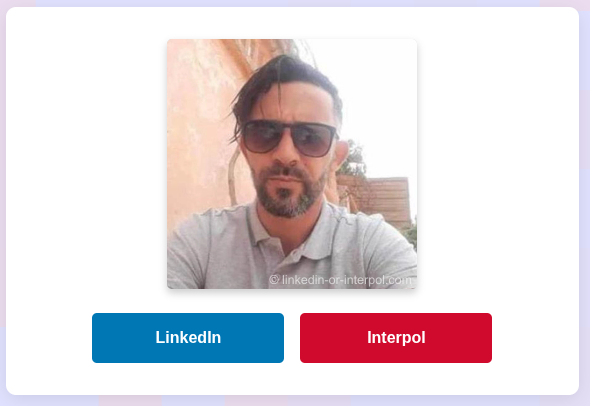
LinkedIn photos are taken from public profiles on professional networking platforms that help people manage their career, connect with colleagues and find jobs, such as LinkedIn.
Interpol photos are taken from official public wanted person notices published by organizations like INTERPOL and similar law enforcement agencies, which share images of fugitives and suspects to help police and the public track them down.
2. A round step by step
- Step 1 - Observe: Look at the face, the expression, the background, the lighting, the eyes... and your gut feeling.
- Step 2 - Decide: Click LinkedIn if you think it's a professional profile photo, or Interpol if you think it is a wanted criminal.
- Step 3 - Reveal: The game immediately tells you if you were right, shows whether it was “LinkedIn” or “Interpol”, and moves on to the next portrait.
Sounds easy... until you realize how similar a smiling CEO and a very polite fugitive can look.
3. Score, total and challenge
At the top of the page, your Score shows how many correct guesses you've made, and Total shows how many rounds you have played so far.
Try to push your accuracy as high as possible, beat your friends, or see how long you can go without being fooled by appearances.
4. Settings and languages

Use the language selector in the top left corner to switch the interface to your preferred language, so you can play comfortably whether you re in English, Français, Español and more.

Visual modifiers (like black and white or blur) may appear as experimental options in the settings panel. When active, they make the portraits harder to read and add an extra layer of challenge to your detective work.
5. Where the photos really come from
Criminal side photos come from official public wanted person lists and notices. for example, INTERPOL's public Red Notices and similar law enforcement databases that share images of suspects and fugitives.
Professional side photos come from public profiles on business oriented social networks like LinkedIn, which is the world's largest online professional network used to build a career, find jobs and connect with colleagues.
We only use images that are already publicly available online, and we do not claim anything beyond what their original sources state. This is a satirical and educational guessing game about how we judge people based on a single photo.
6. What the game is about
“LinkedIn or Interpol” is designed to be funny, a bit unsettling, and provoking: it shows how easily our brain builds stories about people we don't know, just from a profile picture.
Use it to sharpen your attention to detail, reflect on online perception, or simply enjoy the chaos of trying to guess whether that friendly smile belongs to a startup founder... or someone very high on a wanted list.